(this post created on July 6 but re-dated to keep at top)
Last Edit: July 20
Note July 19: With the 2014 report now published, this site is officially open for business. Please see the report, dear reader, and consider yourself invited to comment. A somewhat slow start is expected ...
--
This site is intended as a limited purpose tool to revive interest in and examination of one important event in the brutal and long-running Syrian conflict. This is the Houla Massacre of over 100 civilians on May 25, 2012
* Those needing a refresher on the basics, see Houla Massacre Primer.
It's the one famous for having 49 (or even more) children among the dead, some of them horribly slaughtered - either by Alawite Shabiha from down the road, or by false-flagging foreign-backed terrorists, depending who you ask.
It was the first incident that sparked me to suggest the creation of the research website A Closer Look On Syria (ACLOS) in June, 2012. There I and a few others teamed up to examine this and other incidents. The Houla research spawned several sub-pages, which are/will be organized for usefulness here:
* ACLOS Research Guide
Some key parts of this were partly related, along with works by by a few other authors, in a 2013 report (see page for that here). Now the best form of (arguably) the most potent part of it is packaged in new report:
* The Battle for the Houla Massacre: The Video Evidence Explained (and the rest reconsidered) PDF, 61 pages - Get it here.
I decided a space was needed, at least one, for the evidence to be reviewed and challenged - the new report especially. This site will host that, starting with:
* 2014 Report: Main Challenge Space
(and in more specific posts to come.)
There will also be space (and time?) left for the rest of the evidence, at least parts of it, to get a wider viewing. I'm hoping for lively debate and participatory, comment-driven appeal. I'm currently alerting some minds I'd like to see activated on this, and I hope to hear from them here. This is a complex issue with many parts, and a fair amount of information (mis, dis, and straight) to work with. But with a full blog dedicated to it, it could be thoroughly reviewed, depending how many people put in what kind and amount of energy in what time frame. It's hoped this site and related work will help revive public interest and push for a new and more even-handed investigation.
Any subject posts with comment spaces that someone waishes I would create because I haven't yet - egg me on here.
Monday, August 4, 2014

May 22 Bus Hijacking - Houla Massacre Link?
July 22, 2014
lat edits August 4, 2014I'm not meaning to find things this interesting at the moment, but ... As I just posted in graphic form here at ACLOS, there's some intriguing patterns in a reginal rash of violence on the same Friday as the Houla Massacre, and a bit of stuff right before and after. The details are discussed in the talk page there, worth copying here, but in reverse for variety.

First, a report from October, 2013:
- Lebanese Al Manar TV reported the release of 9 Lebanese pilgrims after 17 months of being held captive by Qatari-backed terrorists in north of Syria.
- On 22 May 2012 a group of terrorists stopped a passenger’s bus near the Turkish borders north of Syria and the passengers were held by a group of anti-Islamic Wahhabi terrorists with direct links to Turkish prime minister office and the Qatari Emir. The terrorists then released the women and children and kept 11 men captive, 2 of them managed to escape after a Syrian Arab Army operation in Azaz last year that killed one of the terrorists leaders responsible of the kidnapping.
I doubt this basic event - the taking of a busload of people including (Shi'ites, it sounds like, from Lebanon) three days before the Houla Massacre and a long ways away - will be disputed. Just where south of the border this happened isn't clear, but presumably way north of the al-Houla area. But another source might help narrow it down, and show the terrorists did not release all their women and children hostages. Nor the driver. Unless maybe there were two busses hijacked that day ...
here's the clincher story, part 1: VDC query - all Hama martyrs May 24 - 7 total. All but the top one play in here. Five represent a family:
* Natania Oreib Al-Saleem, Child - Male
* Yahya Oreib Al-Saleem, Child - Female
* Yakoub Oreib Al-Saleem, Child - Male
* Farouq Oreib Al-Saleem, Child-Male
* Fadwa Al-Shaddeh, Adult Female (mother) (details f/c as needed, available there, including (alive) photos).
These entries tend to say "Date of death: 2012-05-24," "Cause of Death: Kidnapping - Execution" Notes:
"The whole family, consisted of a mother and five children were kidnapped 2 days ago while they were on their way back from Sahl Al-Ghan to Hama. They were executed, and their corpses were found today in Mesyaf. They were slaughtered by knives."Note "Shabiha" or the regime aren't specifically blamed. The VDC, like the SOHR, accepts information from a variety of sources, so maybe no rebels even reported this, just alarmed locals. Who knows? There is apparently one child not listed - maybe not dead for all we know.
Sahl al-Ghan ... not sure how I figured out that means al-Ghab plain, aka Sahl al-Ghab. It's north and west of Hama, and part of the province - its northern panhandle I didn't know about, running north, flanking Latakia up to the Turkish border. It's a large, vague locale to return from. You might drive south to Mesyaf a bit south of its south end, then east to Hama. Or get killed anywhere prior and dumped in Mesyaf - not far from Aqrab, just 16 km direct.

This family wasn't driving their own car back from wherever as far north almost as Turkey. The other relevant victim on that list is Refaat Al-Hussein, adult male, killed also May 24 by "Kidnapping - Torture - Execution." Notes:
"He was a bus driver. He was transporting the family who was slaughtered. His corpse was found too with signs of torture."So ... were there only the six passengers on his bus, or are these seven corpses the residue of a once-larger pool? The date of death isn't clear - found "today," apparently meaning the 24th, after being captured by some kind of bus hijackers two days earlier, is the best reading - so it should be May 22.
If the bus hijackings are the same, and both reports are accurate, we can say it was at the north end of the Al-Ghab plain not far from Turkey and the infiltration points there for foreign Islamists. And if this all lines up, these 7 or so victims of that then proceeded way south with some friends of their captors before getting dumped by the 24th just shy of the arena's edge for the coming Houla Massacre. This has its Aqrab connections - fighters from there swooping south to help, victims from there dying either with the Abdulrazaqs in Taldou, in Aqrab, or both) - and alleged units of unknown foreigners, presumably filtered in via Turkey as usual. This Salem-Shaddeh family might've been the kind of thing a horde of fresh Ottoman mercenaries track in on their boots/sandals.
It might sound like grasping at straws except we must remember video evidence repeatedly backs the witnesses who describe a rebel attack on Taldou the 25th. They say that attack was huge, with 6-800 fighters total. That's an attractive (alleged) force, like a dry sponge is to water. Hundreds of people, probably more than were just hanging around already, would need to swoop in, probably from the north, at about this time, to fill the space that apparently was filled. So I propose it's quite likely the southward journey of that poor Syrian family and their driver is a valuable clue to understanding the Houla Massacre.
Update, August 4:
I just stumbled across the missing Oreib-al-Saleem child: listed as dying earlier, on May 22, VDC victim #16911 Shahd Oreib Al-Saleem], girl, age 4 (rounded down, it appears - see photo). Her notes are the same, kidnapped, slaughtered with knives. A Facebook page is provided: https://www.facebook.com/aribalsalim This was started on May 24 to share photos of the just-killed children. It's all in Arabic and I didn't check the content, but it seems to completely lack rebel colors and icons - and government ones. It was active at least into 2013.

From the VDC entry, her photo at left. What eyes. The name Shahed means "witness," it seems - a girl of that name had her mouth torn off a few days later in al-Houla. Again, what this episode suggests is a mappable movement of child-slaughtering terror towards the site of the Houla Massacre. And it's not from the Alawite villages just south of there, but from the distant and ominous Turkish border to the north. Someone should seal that thing off for good. I think little Shahed would agree.
Saturday, July 26, 2014
The Aqrab Connection
 Aqrab is a mid-sized town of - originally - about 11,000 people. It lies just about 2 km north of the Houla region, and even called a part of Houla in some readings, despite being across the border in Hama province.
The direct Houla Massacre-Aqrab connection is of two parts: fighters from there swooping south to help, and victims from there dying either with the Abdulrazaq familiess in Taldou, in Aqrab, or both.
The indirect connections also are fascinating, with a massacre in each locale about six months apart, each with its own telling patterns covered below. First, the two connections to events of May 25, 2012:
Fighters From:
"Houla" Sunni solidarity rebels from Aqrab reportedly took part in the May 25 battle. The ANNA News witnesses reported:
At 7:00 pm, Al-Farouq brigade, led by Abdulrazak Tlass, of the so-called “Free Syrian Army” arrived. He had more than 250 armed men with him from the city of Rastan, he also had 2 other groups with him one from Al-Qabo village, led by Yehya Al-Yusef, and another from Falla village.These towns sounds like Al-Qabo and Fullah/Fallah - the two main Alawite villages the Shabiha were said to come from. Why are Sunni rebel fighters coming from there too? Apparently not, and this is an especially odd/ironic mix-up. The better telling seems this seems to be based on:
The town was attacked from the north-east by groups of bandits and mercenaries, numbering up to 700 people. The militants came from Ar-Rastan (the Brigade of al-Farouk from the Free Syrian Army led by the terrorist Abdul Razak Tlass and numbering 250), from the village of Akraba (led by the terrorist Yahya Al-Yousef), from the village Farlaha , joined by local gangsters, and from Al Hula.I conclude Qabo = Akraba/Aqrab, and Falla = Farlaha = Kafr Laha, the biggest town of Houla just north of Taldou. Al Hula = elsewhere in, maybe Taldou itself.
Possible verification for the presence of a Yousef family contingent comes from a May 25 victim listed by only the VDC - Saeed Mohammad Munib Al-Yousef "martyr" # 17034. The entry number shows he was reported earlier than most victims, who number well above the 1700s. All the other rebel fighters are listed in this early portion. Age 32 and hailing from Houla (again, sometimes considered to include Aqrab), it says he was a civilian who died in shelling.
Civilian doesn't mean much in this context; another one killed by "shelling" that day was Talal Bakour, # 17017 who the same source notes was the "brother of defected major Nidal Bakour," an alleged leader of one unit involved directly in the massacres. How did his brother get shot if not by fighting or helping alongside his brother? He was dressed in sporty clothes, prepared for physical movement, like the fighters we see on video. The same may go for Saeed al-Yousef, image-free as far as we know. He was likely tagging along with his brother Yehya as they both helped pave the way for the massacres of May 25.
Victims From:
The 2014 list of victims says, as prior sources did, that the whole Fadi Mahmoud Al-Kurdi family "came from Aqrab village." Fadi's wife was an Abdulrazaq - un-listed, unnamed, implicitly a survivor, and by some details likely to be - allegedly - a shot survivor blaming Shabiha and calling herself "Rasha Abdulrazaq." That part is unclear, and the father Fadi also didn't die, by not being in the frame to begin with - off on business or what is unclear. Just the 3 sons and/or 2 of them and, the new list says, a daughter Zeynab Fadi Adulrazaq, age 9. Or, the provided photos might say, all 3 plus the girl. (to be considered better...)
But that wasn't all - these 3-4 kids also had their paternal grandparents fall to assassins that day. Fadi's father, Mahmoud, and his wife Zainab Arouq, both from Aqrab but implicitly - by being listed as Houla Massacre victims - killed in Taldou, in the zone of "Shabiha" invasion. Zainab - the granddaughter's namesake - isn't listed in the 2014 roster unless it's by that reincarnation, but her husband is, with this odd note:
91- Mahmoud Omer Al-kurdi, 45 years old, father, he was resident of Aqrab village and lived in place where massacred happened. (emphasis mine)
The straight reading of that is that he was killed in a part of the "Houla Massacre" that happened in Aqrab where he lived. Nothing else rules that out, nor directly supports it.
Well, Akrama Bakour counters it, saying the "shepherd" al-Kurdi was killed at the entrance to the Abdulrazaq alley on Saad Street. But he seems to place the children both with him and inside Samir Abdulrazaq's house - maybe they were all visiting and he was the last to arrive, caught as he pulled up and killed first. His wife isn't mentioned there. Why this one victim out of all would be jut outside the area is unclear, when he and his wife are also the most likely to have been killed all the way outside of Al-Houla proper. That might be his coded way of explaining how they too came to die by the Shabiha who, we hear, walked to and from Fullah 1.5 km away. He just shifted Mustafa way south to that alley, but not into some house of his own there.
Further, the alleged movement of fighters from there to Taldou means either place is entirely reachable to that force likely in either location. They could hit at least the granparents in Aqrab early on, or just take them captive to kill with the others, before setting out to Taldou at mid-day. Whereas those alleged idiot thugs from Fullah would face a ten km march each way to and from Aqrab. Therefore, Bakour's story that they all happened to be visiting the Abdulrazaq in-laws that day.
Indirect Links: Massacre to Massacre
(modified from the report, pages 51-52)
Just after the Houla Massacre, when allegations of Shia or Alawi victims were widespread, opposition people countered with a blanket claim that anyone killed in Houla was by default a Sunni. That's all that lived in any of its three towns or implicitly in the whole area.
But Aqrab, often considered part of Al-Houla, was then, before, and for another six months, a Sunni majority city with a western Alawite district of about 2,000 people. The world learned faintly about this – and the CIWCL learned much more - after an early December, 2012, attack by rebels from Houla, Aqrab, and Rastan who took over the western district and emptied it. Reports say most inhabitants fed in time, but about 500 civilians were taken hostage. Including children and women, these were mostly of an extended Jubeili family, and perhaps some Melhems, among others. About half of these were freed in exchanges with the government over the following week, with rebels saying nothing to the world.
They only broke the news of an Aqrab Massacre on December 11 - about 200 Alawites in a house were blown up by their “Shabiha” captors, they said, with help from the Syrian army and air force. That story fell apart spectacularly, thanks to an unexpected, spot-on report by Channel 4's Alex Thomson showing that house still standing unscathed the next day. But the fate of the fnal 200-230 or so smoked-out Alawite civilians has never been settled. See the ACLOS page on Aqrab Massacre. I made sure Alex Thomson saw it, and he says it "seems to bear out what I reported from Aqrab at the time."
Either way, after this, opposition sources could say Aqrab was 100% Sunni, the way they said al-Houla was - right after the May massacre. I would caution against reading too much – or too little – into that parallel.
The Aqrab connection increases the possibility of Alawite massacre victims. But with nothing else but an erred suggestion of that (see Houla Massacre Myths) and that they married into a family of alleged Shia converts, we should presume the Kurdis' religious status as simply unknown.
For effect, the rudimentary map we came up with for the few locations we could place in Aqrab - explained here.

Abdulrazaq-Abbara-Clocktower Connection?
This post constitutes a challenge to the 2014 report
<- Return to Main Challenge Space
Challenge brought July 21
last edits July 28
--
I'll bring the first challenge myself, by urging myself to take a second look at one last-minute addition to the report that was a little speculative to start, and was then complicated by some even more last-minute information I wasn't up to making revisions over. This is to be reviewed, I figured, so why not leave this spot ready for an early revisitation?
From page 34: Clocktower Family Massacred?
The 2014 list adds a name missing before: #21 Omamah Abed al-Rahman Abed Al-razaq,32 years old," the mother in the "Bassam Khaled Al-Sweeai family." This is convincing-sounding detail, but the trustworthiness of this list too is in question. For one thing, the four boys became three here, as if to make room for the new mom, but that could mean nothing.
By this list, #41 Amina Shafiq is instead attached to the family of Mouhamed Refiq Abed Al-razaq - lacking the usual maiden name for married-in wives - perhaps a sign of something amiss. By this, she was killed alongside only her daughter Bayan Mouhamed Refiq Abed Al-razaq, age 14 (otherwise just Bayan Mohammed, close enough). Amina's husband apparently survived, unlike victim #99 Mouhammed Shafiq Abbara, who died alongside no family members at all. Both wound up seeming lonely like that - another possible sign they've been forcibly split up.
Considering, then: Akrama Bakour's "Mohammed Shafiq Abdulrazaq" - oddly listed right before "Mohammad Abbara and his daughter Amina" - would presumably be the husband M. Refiq, just named a bit wrong. But here, he didn't implicitly survive, but rather he explicitly died. And he then appeared on no lists ... unless it's as M.S. Abbara... (listed twice then by Akrama, unless there really were two Mohammeds, one actually being her father ...)
So there are two different ways the Al-Sweiee boys might connect to the Abdulrazaqs via their mother. One I guessed, the other is provided by the new list. It's possible neither is right, but one likely is.
Any link to the Abbaras remains speculative, built into my guess link for the Sweiee boys. But supporting it we have Bakour's Abbara-related "family of 7" with its implications of such a relation; at the verty least, consider that listing excludes the Al-Sayeds, and so seems to focus on the Abdulrazaqs and their relations exclusively. The surrounding name suggestions, and otherwise unexplained "family of 7" all further suggest that was a pretty good guess.
If there were a relation here, the killing that day of any of any Abbaras - by "shelling" or whatever - was most likely a planned part of the same targeted operation against the families down Saad Street. It seems Abbaras were killed at a place rebels definitely overran. That alone might be adequate reason to confuse this link with smudged identities and a made-up last name leaving such speculation the only way to piece the puzzle together. It might look like this:
* Father Mohammed Shafiq Abdulrazaq and mother Amina Mohammed Abbara - have their last names simply swapped, ages adjusted if needed. They both get the Shafiq part, leaving a clue.
* Five children for a family of 7 total: eldest, daughter Bayan Mohammed is kept the same, and the four boys, last names changed to Al-Sweiee, first names also possibly changed. Later a different mother is made up to explain them.
* Amina's father Mohammed Abbara was deleted from the listings, and the once-damning Abdulrazaq-Abbara link would thus be obscured.

 Above: composite panorama of the military portion of the overrun clocktower area on May 30 (not May 27)
Location (??) at left. They lived somewhere in there, some say.
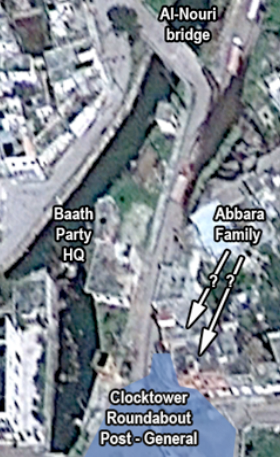
Another note to add: a belated search on Wikimapia bears out the general picture of an Abbara family at the clocktower roundabout. At least five labels - placed by whoever and based on whatever - suggest they own several homes and perhaps surrounding land, dominating the center of town aside from the mosque and cemetery.
First, the indicated block of houses has a label the right shape to include the whole thing, but offset some meters east. Translated, it says "(goods/retail/accessories) house Abbara Daoud 7." It seems to include the very corner building and everything north - about 7 buildings, likely then what the 7 refers to. Town center in a block of buildings you own would be a good place to open a shop, become fairly wealthy, intermarry, basically host the Army ... In the image above, it would either be around the corner ahead, or in the space now used as the Army post. Maybe it's what was commandeered, likely with some reimbursement from the government, and you can see where that kind of thing might raise some eyebrows...
Next, three patches of land and homes south of the roundabout are also listed as home to Abbara men:
* Just south of the clocktower, related: House Hajj (aged) Abdul Karim Abbara. God rest his soul. Grandson, Daoud Abbara
* A bit west of that: House of Nazir and Bahaa Abbara
* A bit further west: House of Hosni Abbara + Yahya Salim Abbara
And, it says, there's at least one more home in a marked block just northwest of the mosque - Engineer (المهندس - Mohandis) Mohammed Iyad Abbara Abu Ubaida - that's a more likely match than the shop block for an indirect Abdulrazaq family in the northwest, but maybe a better yet explanation is the true one.
Mapped out, labels shifted a bit to make more sense:

<- Return to Main Challenge Space
Challenge brought July 21
last edits July 28
--
I'll bring the first challenge myself, by urging myself to take a second look at one last-minute addition to the report that was a little speculative to start, and was then complicated by some even more last-minute information I wasn't up to making revisions over. This is to be reviewed, I figured, so why not leave this spot ready for an early revisitation?
From page 34: Clocktower Family Massacred?
A German-language map ACLOS cited early on says this small block of buildings includes the home of a family Abbara. [18] This is based on ANNA News and “the Defector” who said “the house on the northern corner of the square belongs to the family Abbara.” [11] It's not clear to what extent this corner was the family's house vs. the Army's base.Re-Considered:
FSA fighter Akrima Bakour told the BBC one Mohammad Abbara along with "his daughter Amina and her family of seven" were "killed in the massacre" [15] The Opposition VDC may reflect this, but differently. Only two victims of that name appear as killed in Houla that day, both adult men killed by “shelling.” The younger is Ammar, age 23. [19] There is one Amina listed at the VDC (as “Amna” - a typo) - Amina Shafeeq Abdul Razaq, age 43, executed. She was “married and has 5 children,” a note shared by several other female victims there, but only one male: Mohammad Shafiq Abbara, age 27. The shared Shafiq suggests brother, usually, not husband. But wasn't he Amina's father? Bakour put the Shafiq on another guy listed with them - Mohammad Shafiq Abdul Razaq.
There are also an unclaimed batch of four boys named Al-Sweiee, and given with “mother's name: Amama” (There is a female name Amima, but like Amna, Amama is not a known (common) name) [19] It's possible this somehow correlates to the same family of seven, obscured with this confusing record. Otherwise, perhaps they didn't get this one fully reported, but is seems connected to both this spot and that family.
There's some talk of an Abdulrazaq family killed in the north of town; “the Defector” said “the second family, who was killed by the bandits, lived [partly] in the northwest. Even there, the family Abdul Rasak has a house.” [7] Maybe it wasn't in the northwest of town they lived, but on the northeast corner of that center of town, well north of the other Abdulrazaqs.
So there is compelling – if little-noted - evidence that a family basically living at a security post rebels overran was massacred on that day. They probably would not have been rounded up and eliminated during the mid-day distraction, but after 7:00, the time Arifah specifies the event even the CoI acknowledges with “the clocktower checkpoint was overrun.”
The 2014 list adds a name missing before: #21 Omamah Abed al-Rahman Abed Al-razaq,32 years old," the mother in the "Bassam Khaled Al-Sweeai family." This is convincing-sounding detail, but the trustworthiness of this list too is in question. For one thing, the four boys became three here, as if to make room for the new mom, but that could mean nothing.
By this list, #41 Amina Shafiq is instead attached to the family of Mouhamed Refiq Abed Al-razaq - lacking the usual maiden name for married-in wives - perhaps a sign of something amiss. By this, she was killed alongside only her daughter Bayan Mouhamed Refiq Abed Al-razaq, age 14 (otherwise just Bayan Mohammed, close enough). Amina's husband apparently survived, unlike victim #99 Mouhammed Shafiq Abbara, who died alongside no family members at all. Both wound up seeming lonely like that - another possible sign they've been forcibly split up.
Considering, then: Akrama Bakour's "Mohammed Shafiq Abdulrazaq" - oddly listed right before "Mohammad Abbara and his daughter Amina" - would presumably be the husband M. Refiq, just named a bit wrong. But here, he didn't implicitly survive, but rather he explicitly died. And he then appeared on no lists ... unless it's as M.S. Abbara... (listed twice then by Akrama, unless there really were two Mohammeds, one actually being her father ...)
So there are two different ways the Al-Sweiee boys might connect to the Abdulrazaqs via their mother. One I guessed, the other is provided by the new list. It's possible neither is right, but one likely is.
Any link to the Abbaras remains speculative, built into my guess link for the Sweiee boys. But supporting it we have Bakour's Abbara-related "family of 7" with its implications of such a relation; at the verty least, consider that listing excludes the Al-Sayeds, and so seems to focus on the Abdulrazaqs and their relations exclusively. The surrounding name suggestions, and otherwise unexplained "family of 7" all further suggest that was a pretty good guess.
If there were a relation here, the killing that day of any of any Abbaras - by "shelling" or whatever - was most likely a planned part of the same targeted operation against the families down Saad Street. It seems Abbaras were killed at a place rebels definitely overran. That alone might be adequate reason to confuse this link with smudged identities and a made-up last name leaving such speculation the only way to piece the puzzle together. It might look like this:
* Father Mohammed Shafiq Abdulrazaq and mother Amina Mohammed Abbara - have their last names simply swapped, ages adjusted if needed. They both get the Shafiq part, leaving a clue.
* Five children for a family of 7 total: eldest, daughter Bayan Mohammed is kept the same, and the four boys, last names changed to Al-Sweiee, first names also possibly changed. Later a different mother is made up to explain them.
* Amina's father Mohammed Abbara was deleted from the listings, and the once-damning Abdulrazaq-Abbara link would thus be obscured.
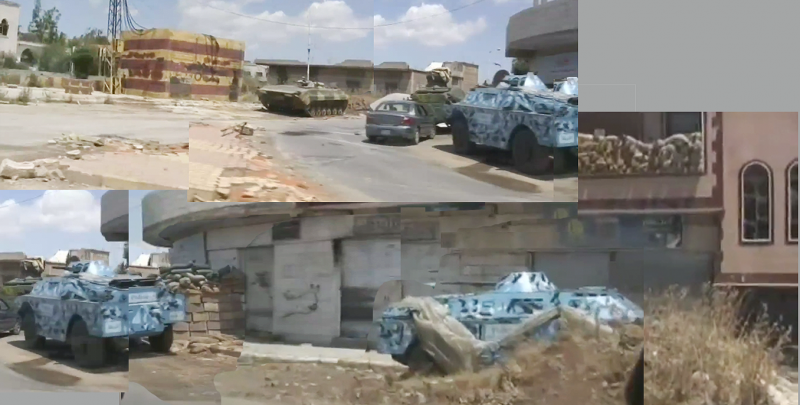
 Above: composite panorama of the military portion of the overrun clocktower area on May 30 (not May 27)
Location (??) at left. They lived somewhere in there, some say.
Another note to add: a belated search on Wikimapia bears out the general picture of an Abbara family at the clocktower roundabout. At least five labels - placed by whoever and based on whatever - suggest they own several homes and perhaps surrounding land, dominating the center of town aside from the mosque and cemetery.
First, the indicated block of houses has a label the right shape to include the whole thing, but offset some meters east. Translated, it says "(goods/retail/accessories) house Abbara Daoud 7." It seems to include the very corner building and everything north - about 7 buildings, likely then what the 7 refers to. Town center in a block of buildings you own would be a good place to open a shop, become fairly wealthy, intermarry, basically host the Army ... In the image above, it would either be around the corner ahead, or in the space now used as the Army post. Maybe it's what was commandeered, likely with some reimbursement from the government, and you can see where that kind of thing might raise some eyebrows...
Next, three patches of land and homes south of the roundabout are also listed as home to Abbara men:
* Just south of the clocktower, related: House Hajj (aged) Abdul Karim Abbara. God rest his soul. Grandson, Daoud Abbara
* A bit west of that: House of Nazir and Bahaa Abbara
* A bit further west: House of Hosni Abbara + Yahya Salim Abbara
And, it says, there's at least one more home in a marked block just northwest of the mosque - Engineer (المهندس - Mohandis) Mohammed Iyad Abbara Abu Ubaida - that's a more likely match than the shop block for an indirect Abdulrazaq family in the northwest, but maybe a better yet explanation is the true one.
Mapped out, labels shifted a bit to make more sense:
Saturday, July 19, 2014
Houla Massacre Myths
(post created July 19, to be filled in)
last edits Jan, 12, 2015
Minor/Early-Settled Myths
(see also ACLOS: proven false claims)
These distortions were highlighted by critics during the short span there were lots of people talking about it. They're generally too common, obvious, or unimportant to interest me much past initial discovery.
- The victims were mainly killed by the Army shelling:
The alleged Army shelling was clearly emphasized in all early reports, and some of the earliest do imply that alone caused the death toll, initially reported smaller but growing as bodies were pulled from "beneath rubble". For example, one report as late as the 28th said it was now 90 people who were killed in "the shelling." This may be mere instinct when that claim was common following such events - and they always specify artillery only the military has, never mortars, RPGs, improvised rockets - things they have. So there's been an emphasis on this aspect to clarify the blame, but rebels said from the beginning, at first muddled but soon clearer, that there were also horrific in-home massacres - by "Shabiha" - after the shelling.
- BBC Iraq image: Another popular point of criticism was an early image the BBC ran that made the massacre look simply enormous - it showed hundreds of wrapped bodies that, as readers quickly discovered, died in Iraq years earlier and had the photo already used for that. It was an undeniable error of some sort, quickly acknowledged by the BBC and retracted (see here for their explanation). There may be more theorizing about true reasons, etc. but it didn't seem worth digging for.
- Army artillery tracks were seen from space:
The BBC, again but less known, cited a supposed expert who found likely artillery tracks in May 26 satellite images. This was the first point I tackled, and easily destroyed: Suspected Tree Farm Reveals Houla Massacre Deception. On checking past imagery, I could prove these sinister "tracks" far south of town predated the massacre by at least three months, and seem to be planting roads in a tree farm. Later 2013 images in Google Earth show they've remained unused and faded away since - and in their place, the kind of tracks he meant appeared at the place (the "Water Company") one would have seen them on the 26th if they existed. But they apparently did not exist then.
Crucial Myths
(mostly forthcoming)
- Army shelling preceding the massacre is proven: As Syrian authorities and others noted, here and elsewhere, of the bodies shown, none of them is jumbled, broken and dusty like victims pulled from "beneath rubble" would be, though a very few look like people hit with RPGs in the open). There's no video proof of shelling that isn't at least as consistent with the evidenced rebel offensive. But there are various signs and thinking that have been cited to convince millions - even Russia's diplomats - that the Army shelled Taldou that day. This deserves its own post (f/c)
- The Shelling Was Because "Houla" is a "rebel-held town":
This was a strong theme of the Houla Massacre article at Wikipedia until I stepped in recently to clarify some things. "Two otion-held towns" is not Taldou. The vague impression of general Houla control coupled with vague reports of shelling and a massacre in "Houla," often called a singular "town," is misleading. As I said, it "makes it sound like only anti-rebel people would attack an all-rebel town, or all-rebel towns in that area." In fact, as the main article now clarifies,
Rebels took over security posts there, on that very day, and set them smoldering. There were five, and the UN acknowledge two of them as overrun by rebels in some kind of offensive. Two others are contested. One of the contested posts is 120 meters north of one massacre site. Another is exactly across the street from another massacre site, and positioned to defend the remainder, the UN decided, as long as it wasn't, say, overrun and torched by sunset. They didn't think it was, but the video record suggests otherwise.
In this context, some stupid quotes, all from a single horrendous Al-Jazeera report:
* "Hadi al-Abdallah, speaking from Homs, said Houla is under the control of the Free Syrian Army, which means government troops cannot enter the town. Instead, they are launching shells from a distance in a bid to defeat the rebels."
* "...government forces tried to break into the town, the UK-based Syrian Observatory for Human Rights said."
* "A team of UN observers visited the Homs area to assess the situation on Saturday. Some activists complained, however, that they just visited the village of Taldou, at the edge of Houla, rather than entering the town."
Fact: someone shelled a part of Houla, just with mortars, RPGs, and heavy guns on "ratmobiles," as far as we can tell. It was the one area in Houla that ''rebel troops'' could not enter, the government-controlled southern half of Taldou. Everything relevant was there, all the damage, the massacre sites, and even the mass grave in the northern, rebel-held half (and the monitors went there, twice, and heard plenty of lies and also a hushed-up "other story") The same logic behind Al-Jazeera's sources, better informed, would dictate that rebels pounded the center and south of town from their nearby positions in Houla, including north Taldou, to defeat those holding it. Then, logically, they must have entered like they usually could not, and conducted the massacre against the people the soldiers had just been protecting. If all we had to go on was the fact that Taldou was government-held, this would be a lazy leap to blame the rebels. But we also have the video record that shows them taking out the posts they would need to for this to be the reality.
- Rebels Withdrew Before the Massacres:
As explained above, they could only withdraw from the affected area if they first entered it, which would require a military offensive to knock out security posts. Then, as the video proves, they had to come back in a short time and again access the place to recover the bodies they were then seen with. In fact, it's most logical to presume they forced their entry before the massacre, stayed during it, and then got the bodies because they just killed them.
- The Mobile Post was Never Overrun:(f/c)
- The Hospital Remained Functional:(f/c)
- "The crime scene remained in Government-controlled territory the entire time":(f/c)
- Children's Throats Were Slit: (f/c)
- The Way Children Were Killed Does NOT Suggest Islamists:(f/c)
- There was no Conversion for the Abdulrazaq Family: (f/c)
- Alawites were Killed in the Houla Massacre:
The famous June report by journalist Rainer Hermann in Germany's Frankfurter Allgemeine Zeitung (FAZ) passed on that (as translated) the victims “were nearly exclusively families from the Alawi and Shia minorities in Houla” or government loyalist Sunnis. As noted with glee by critics, the Alawite part is technically an error. Hermann was told that "members of the Alawi family Shomaliya." were among the dead, but there's no such family. Activists also say there were no Alawites in Houla, but that appears unproven - it seems fairly close to or possibly zero, but not close enough or sure enough to rule it out. Rather, a lack of correct positive evidence leaves it not even really trying to be ruled in any longer.
- Rebels Did Not Massacre Alawite Civilians That Day:
Following on the last point, if no Alawite family was killed in Houla, all would seem well on that front. Except there is a whole true version few have bothered looking for. Rather, it seems at least ten civilians from two families in the Alawite village of al-Shumariyeh (not the family Shomaliya) were allegedly killed in a separate attack of May 25 (perhaps later that night or early on the 26th). On the south shore of Lake Homs, the Shumariyeh Massacre is too far away to be done by the same people, and was reportedly run by rebels out of al-Qusayr. But the two massacres might have been coordinated to send a signal about as implied in the FAZ piece – to terrorize Sunnis who convert, Sunnis who support the “Alawite regime,” and Alawi.
- "the loyalties of the victims" point to Shabiha: (f/c)
- Witnesses can be Trusted: (f/c)
- Okay, I mean IF they blame Shabiha: (f/c)
- It makes sense to let Shabiha massacre families in a campaign of genocide against the country's Sunni Majority: WTF?
- There is a "lack of credible information supporting other possibilities": This statement by the CoI has been shown wrong by the new report. Strong video evidence of a rebel offensive the offeders deny is more credible by far than rebel-supplied alleged witnesses who blame the same people rebels do, and clash with the video record just like they do.
last edits Jan, 12, 2015
Minor/Early-Settled Myths
(see also ACLOS: proven false claims)
These distortions were highlighted by critics during the short span there were lots of people talking about it. They're generally too common, obvious, or unimportant to interest me much past initial discovery.
- The victims were mainly killed by the Army shelling:
The alleged Army shelling was clearly emphasized in all early reports, and some of the earliest do imply that alone caused the death toll, initially reported smaller but growing as bodies were pulled from "beneath rubble". For example, one report as late as the 28th said it was now 90 people who were killed in "the shelling." This may be mere instinct when that claim was common following such events - and they always specify artillery only the military has, never mortars, RPGs, improvised rockets - things they have. So there's been an emphasis on this aspect to clarify the blame, but rebels said from the beginning, at first muddled but soon clearer, that there were also horrific in-home massacres - by "Shabiha" - after the shelling.
- BBC Iraq image: Another popular point of criticism was an early image the BBC ran that made the massacre look simply enormous - it showed hundreds of wrapped bodies that, as readers quickly discovered, died in Iraq years earlier and had the photo already used for that. It was an undeniable error of some sort, quickly acknowledged by the BBC and retracted (see here for their explanation). There may be more theorizing about true reasons, etc. but it didn't seem worth digging for.
- Army artillery tracks were seen from space:
The BBC, again but less known, cited a supposed expert who found likely artillery tracks in May 26 satellite images. This was the first point I tackled, and easily destroyed: Suspected Tree Farm Reveals Houla Massacre Deception. On checking past imagery, I could prove these sinister "tracks" far south of town predated the massacre by at least three months, and seem to be planting roads in a tree farm. Later 2013 images in Google Earth show they've remained unused and faded away since - and in their place, the kind of tracks he meant appeared at the place (the "Water Company") one would have seen them on the 26th if they existed. But they apparently did not exist then.
Crucial Myths
(mostly forthcoming)
- Army shelling preceding the massacre is proven: As Syrian authorities and others noted, here and elsewhere, of the bodies shown, none of them is jumbled, broken and dusty like victims pulled from "beneath rubble" would be, though a very few look like people hit with RPGs in the open). There's no video proof of shelling that isn't at least as consistent with the evidenced rebel offensive. But there are various signs and thinking that have been cited to convince millions - even Russia's diplomats - that the Army shelled Taldou that day. This deserves its own post (f/c)
- The Shelling Was Because "Houla" is a "rebel-held town":
This was a strong theme of the Houla Massacre article at Wikipedia until I stepped in recently to clarify some things. "Two otion-held towns" is not Taldou. The vague impression of general Houla control coupled with vague reports of shelling and a massacre in "Houla," often called a singular "town," is misleading. As I said, it "makes it sound like only anti-rebel people would attack an all-rebel town, or all-rebel towns in that area." In fact, as the main article now clarifies,
"the UN's June report noted "Government forces are present in Al-Houla" with "fortified checkpoints" they show on an attached map. This shows only the south end of Taldou, between rebel-held Houla and the Alawi and Shia villages. All the reported massacre sites, also labeled on that map, are in this immediate area of Taldou. [26]"
Rebels took over security posts there, on that very day, and set them smoldering. There were five, and the UN acknowledge two of them as overrun by rebels in some kind of offensive. Two others are contested. One of the contested posts is 120 meters north of one massacre site. Another is exactly across the street from another massacre site, and positioned to defend the remainder, the UN decided, as long as it wasn't, say, overrun and torched by sunset. They didn't think it was, but the video record suggests otherwise.
In this context, some stupid quotes, all from a single horrendous Al-Jazeera report:
* "Hadi al-Abdallah, speaking from Homs, said Houla is under the control of the Free Syrian Army, which means government troops cannot enter the town. Instead, they are launching shells from a distance in a bid to defeat the rebels."
* "...government forces tried to break into the town, the UK-based Syrian Observatory for Human Rights said."
* "A team of UN observers visited the Homs area to assess the situation on Saturday. Some activists complained, however, that they just visited the village of Taldou, at the edge of Houla, rather than entering the town."
Fact: someone shelled a part of Houla, just with mortars, RPGs, and heavy guns on "ratmobiles," as far as we can tell. It was the one area in Houla that ''rebel troops'' could not enter, the government-controlled southern half of Taldou. Everything relevant was there, all the damage, the massacre sites, and even the mass grave in the northern, rebel-held half (and the monitors went there, twice, and heard plenty of lies and also a hushed-up "other story") The same logic behind Al-Jazeera's sources, better informed, would dictate that rebels pounded the center and south of town from their nearby positions in Houla, including north Taldou, to defeat those holding it. Then, logically, they must have entered like they usually could not, and conducted the massacre against the people the soldiers had just been protecting. If all we had to go on was the fact that Taldou was government-held, this would be a lazy leap to blame the rebels. But we also have the video record that shows them taking out the posts they would need to for this to be the reality.
- Rebels Withdrew Before the Massacres:
As explained above, they could only withdraw from the affected area if they first entered it, which would require a military offensive to knock out security posts. Then, as the video proves, they had to come back in a short time and again access the place to recover the bodies they were then seen with. In fact, it's most logical to presume they forced their entry before the massacre, stayed during it, and then got the bodies because they just killed them.
- The Mobile Post was Never Overrun:(f/c)
- The Hospital Remained Functional:(f/c)
- "The crime scene remained in Government-controlled territory the entire time":(f/c)
- Children's Throats Were Slit: (f/c)
- The Way Children Were Killed Does NOT Suggest Islamists:(f/c)
- There was no Conversion for the Abdulrazaq Family: (f/c)
- Alawites were Killed in the Houla Massacre:
The famous June report by journalist Rainer Hermann in Germany's Frankfurter Allgemeine Zeitung (FAZ) passed on that (as translated) the victims “were nearly exclusively families from the Alawi and Shia minorities in Houla” or government loyalist Sunnis. As noted with glee by critics, the Alawite part is technically an error. Hermann was told that "members of the Alawi family Shomaliya." were among the dead, but there's no such family. Activists also say there were no Alawites in Houla, but that appears unproven - it seems fairly close to or possibly zero, but not close enough or sure enough to rule it out. Rather, a lack of correct positive evidence leaves it not even really trying to be ruled in any longer.
- Rebels Did Not Massacre Alawite Civilians That Day:
Following on the last point, if no Alawite family was killed in Houla, all would seem well on that front. Except there is a whole true version few have bothered looking for. Rather, it seems at least ten civilians from two families in the Alawite village of al-Shumariyeh (not the family Shomaliya) were allegedly killed in a separate attack of May 25 (perhaps later that night or early on the 26th). On the south shore of Lake Homs, the Shumariyeh Massacre is too far away to be done by the same people, and was reportedly run by rebels out of al-Qusayr. But the two massacres might have been coordinated to send a signal about as implied in the FAZ piece – to terrorize Sunnis who convert, Sunnis who support the “Alawite regime,” and Alawi.
- "the loyalties of the victims" point to Shabiha: (f/c)
- Witnesses can be Trusted: (f/c)
- Okay, I mean IF they blame Shabiha: (f/c)
- It makes sense to let Shabiha massacre families in a campaign of genocide against the country's Sunni Majority: WTF?
- There is a "lack of credible information supporting other possibilities": This statement by the CoI has been shown wrong by the new report. Strong video evidence of a rebel offensive the offeders deny is more credible by far than rebel-supplied alleged witnesses who blame the same people rebels do, and clash with the video record just like they do.
Suggested Posts
July 19
There's a lot of material to cover, much already done but needing improvements, distillation and summarization, perhaps here. I'm not sure how many posts it's wide to create, and in what order. Here I'll let readers suggest issues they'd like to add to, or see covered. Each new post gives me space (if not time) to explain. And it gives readers comment space, and defines what it is. So let me know what comments or questions you have and I'll create a space for that.
There's a lot of material to cover, much already done but needing improvements, distillation and summarization, perhaps here. I'm not sure how many posts it's wide to create, and in what order. Here I'll let readers suggest issues they'd like to add to, or see covered. Each new post gives me space (if not time) to explain. And it gives readers comment space, and defines what it is. So let me know what comments or questions you have and I'll create a space for that.
Thursday, July 17, 2014
Witness Reliability
Post started July 17
Last edited December 17
At A Closer Look On Syria, we've opted for the term "alleged witnesses" to describe people on both sides of the Houla Massacre narrative schism - Houla: Alleged Witnesses. Here, we will gather some thoughts on reliability, pro and con, for both sets, and cite some examples.
(July 18 note: "We will" meaning we have/will, and I will organize some reflection of that here soon - to start, two samples in a category to show how we can critique witnesses from both sides)
Problematic Witnesses - Rebel Guilt Narrative:
1) "Arifah": Meaning 'a knowledgeable woman," this is the reference name ACLOS gave to the female half of the leading two witnesses presented by SANA et al. in early June. She claims much knowledge, but seemingly gathered it in a variety of ways; some visual observation but mostly listening to a radio scanner and second-hand information, including a litany of past rebel abuses many would question (we would suggest none of it's that far-fetched, but let's just not get distracted)
The UN's investigators concluded these two leading witnesses were the only ones in existence supporting a rebel attack. Between them, they almost totally ignore the "rebel defector" (as we dubbed him) with his detailed inside knowledge as a participant in the Battle for the Houla Massacre. They focused their criticism on "Arifah," partly with valid points.
(details forthcoming)
2) "Ahmed": There is one witness for the rebel guilt narrative who classes as a "miracle survivor," although not the usual "I hid behind a door" "they thought I was dead" type. He says he's an Abdulrazaq family member accused of coverting to Shi'ism, but had worked with local rebels before. So, he says, rebels he knew willingly spared him and his whole family (and then smuggled them out, let them just walk away amid the attack, had them stay put through it, or what, is all left unclear). All-in-all, "Ahmed," as he was called, has a problematic account. It raises a number of questions and doesn't answer them, and gives few details. It's far from ruled out, but neither does it seem sound enough to hang much weight on.
(source: Syria: German Author Todenhöfer met with Eyewitness from al-Houla Jurgen Todennhöfer, originally published in the German magazine Bild as Mein Treffen mit Assad, 9 July, 2012)
3) Others: most of the dozen or so interviewees just get one line comments, most of them showing no deeper insight than a general rebel attack they only each saw a part of. They complain that it left police and soldiers dead, houses and the hospital burnt, people displaced, and so on. Only the two leading witnesses, the Defector and Arifah, give much useful detail, one of those with some substantial and identifiable problems, the other without.
Problematic Witnesses - Shabiha Guilt Narrative:
Any rebel-absolvers reading this who were just tempted to write off "Ahmed" as an obvious liar with an implausible survival story, take careful note here: he's the only one like that on that side. Conversely, opposition activists put forth at least 34-37 alleged miracle survivors, with at least 18 on record as witnesses who speak of or for the other half (explained here). If the "Shabiha" killed 106 and failed with 34, that's 140 at least intended, for a fail rate of no less than 24%. These generally unharmed people relate a cartoonish assault by idiot-brute villains who cut deals for no one, try to kill everyone, and fail a lot. Three different women claim they survived by hiding behind a door. One says she ran when one Shabih shot another by accident. Some hid in the barn, some played dead, passed out, etc.
Some claim to be shot and might be. Some of the many people shown might be real survivors, shot and now in rebel custody, telling the rebel story - maybe because it's true, maybe for other reasons. They all consistently blame Shabiha and claim total innocence for local rebels and themselves. Like all Syrians, they suggest, the victims were peaceful rebel sympathizers who detest Bashar Al-Assad. They fail to mention in any form the rebel-initiated Battle for the Houla Massacre that came right before the massacre. No rebels were around then, only afterwards to save the survivors, praise God. So they say.
Just to highlight a few of particular unreliability (and with many runners-up):
1) "Ali Al-Sayed"
Little "Ali Adel Al-Sayed, age 11 (visually about 9) says he played dead. In one version he says he did that by putting his hand over his face - it was bloody from being shot. But it was healed up within a few days, leaving only a faint scratch he shows as proof on that video. Compelling? Yes, apparently. He's adorable, and was nearly murdered by Assad. You just don't go questioning someone like that, and so few did.
We started with him in June, 2012, and I had a detailed article up by July 3. In his multiple accounts, he gives three different names for his father, with the unused names swapped in alternately for his older brother and his uncle(s). He ... wow, he just has too much wrongness to relate here.
The original article was expanded for the 2013 report, including the important correlation thatb he claims to represent the contested family allegedly related to the new parliament secretary Abdelmutti Al-Mashlab. Ali, the inconsistent malleable child witness, paints Aref Al-Sayed's family as distantly related, not a plausible motive, with no real political leaning except some flirtation with protests. But he cannot consistently remember the names of his elder male relatives or when and how they were killed (shot outside first, shot last after hiding through the massacre - behind a door - or killed later after they were taken away alive).
This is the adorable star witness. His stories don't make much sense, but he recognized the Alawite accents and knows the International Community is supposed to be protecting them. Shame on all of, ays little Ali.
See also 2014 version of 2013 revision published on-site, here: "Fight for us" and other things Ali said
2) Ayman/Hassan/Abu Firas Abdulrazaq:
(forthcoming)
3) Malik Bakour:
Defected soldier Malik Baqur (Bakour) gives one account (Der Speigel, video) where he was at the “protest” in the center of Taldou when he “received a message from the troops along Sadd [Saad] Street telling us that a group was coming from the next village” (that being Fullah, but they knew some were also from Alkabo (Alawi) and Algur (Shia) beyond). Who these well-informed “troops” are is unexplained and interesting. Then Malik says he walked down Saad, arriving at a spot “300 meters from the massacre area” in time to see the Alawite Shabiha marching all the way back to Fullah at 6:30, with a truck he recognized from a checkpoint there. He does not claim that they left behind a list of participants, but Malik's story is almost that perfectly preposterous.
But he also says (Spiegel, text) that he was already at the home of his cousin on Saad Street, doing nothing in particular until the invasion and massacre (defected major Jihad Raslan told Spiegel he was at his own home doing nothing, 300 meters from the crime scene, and hooked up with Malik to inspect hoimes right after). This latter story, lining up with Jihad's, suggests there was no fight – or even protest - for them to be out in, which seems to be untrue. Also, one or both of Malik's stories – both of them confusingly published by Der Spiegel – must be untrue.
(Source: "Searching for the Truth Behind the Houla Massacre" By Christoph Reuter and Abd al-Kadher Adhun, Der Spiegel, July 23, 2012(for text part), video interviews for the video interview)
4) Rasha and Rasha:
(forthcoming)
5) "Fatima":
(forthcoming)
remaining content, any others, forthcoming.
Last edited December 17
At A Closer Look On Syria, we've opted for the term "alleged witnesses" to describe people on both sides of the Houla Massacre narrative schism - Houla: Alleged Witnesses. Here, we will gather some thoughts on reliability, pro and con, for both sets, and cite some examples.
(July 18 note: "We will" meaning we have/will, and I will organize some reflection of that here soon - to start, two samples in a category to show how we can critique witnesses from both sides)
Problematic Witnesses - Rebel Guilt Narrative:
1) "Arifah": Meaning 'a knowledgeable woman," this is the reference name ACLOS gave to the female half of the leading two witnesses presented by SANA et al. in early June. She claims much knowledge, but seemingly gathered it in a variety of ways; some visual observation but mostly listening to a radio scanner and second-hand information, including a litany of past rebel abuses many would question (we would suggest none of it's that far-fetched, but let's just not get distracted)
The UN's investigators concluded these two leading witnesses were the only ones in existence supporting a rebel attack. Between them, they almost totally ignore the "rebel defector" (as we dubbed him) with his detailed inside knowledge as a participant in the Battle for the Houla Massacre. They focused their criticism on "Arifah," partly with valid points.
(details forthcoming)
2) "Ahmed": There is one witness for the rebel guilt narrative who classes as a "miracle survivor," although not the usual "I hid behind a door" "they thought I was dead" type. He says he's an Abdulrazaq family member accused of coverting to Shi'ism, but had worked with local rebels before. So, he says, rebels he knew willingly spared him and his whole family (and then smuggled them out, let them just walk away amid the attack, had them stay put through it, or what, is all left unclear). All-in-all, "Ahmed," as he was called, has a problematic account. It raises a number of questions and doesn't answer them, and gives few details. It's far from ruled out, but neither does it seem sound enough to hang much weight on.
(source: Syria: German Author Todenhöfer met with Eyewitness from al-Houla Jurgen Todennhöfer, originally published in the German magazine Bild as Mein Treffen mit Assad, 9 July, 2012)
3) Others: most of the dozen or so interviewees just get one line comments, most of them showing no deeper insight than a general rebel attack they only each saw a part of. They complain that it left police and soldiers dead, houses and the hospital burnt, people displaced, and so on. Only the two leading witnesses, the Defector and Arifah, give much useful detail, one of those with some substantial and identifiable problems, the other without.
Problematic Witnesses - Shabiha Guilt Narrative:
Any rebel-absolvers reading this who were just tempted to write off "Ahmed" as an obvious liar with an implausible survival story, take careful note here: he's the only one like that on that side. Conversely, opposition activists put forth at least 34-37 alleged miracle survivors, with at least 18 on record as witnesses who speak of or for the other half (explained here). If the "Shabiha" killed 106 and failed with 34, that's 140 at least intended, for a fail rate of no less than 24%. These generally unharmed people relate a cartoonish assault by idiot-brute villains who cut deals for no one, try to kill everyone, and fail a lot. Three different women claim they survived by hiding behind a door. One says she ran when one Shabih shot another by accident. Some hid in the barn, some played dead, passed out, etc.
Some claim to be shot and might be. Some of the many people shown might be real survivors, shot and now in rebel custody, telling the rebel story - maybe because it's true, maybe for other reasons. They all consistently blame Shabiha and claim total innocence for local rebels and themselves. Like all Syrians, they suggest, the victims were peaceful rebel sympathizers who detest Bashar Al-Assad. They fail to mention in any form the rebel-initiated Battle for the Houla Massacre that came right before the massacre. No rebels were around then, only afterwards to save the survivors, praise God. So they say.
Just to highlight a few of particular unreliability (and with many runners-up):
1) "Ali Al-Sayed"
Little "Ali Adel Al-Sayed, age 11 (visually about 9) says he played dead. In one version he says he did that by putting his hand over his face - it was bloody from being shot. But it was healed up within a few days, leaving only a faint scratch he shows as proof on that video. Compelling? Yes, apparently. He's adorable, and was nearly murdered by Assad. You just don't go questioning someone like that, and so few did.
We started with him in June, 2012, and I had a detailed article up by July 3. In his multiple accounts, he gives three different names for his father, with the unused names swapped in alternately for his older brother and his uncle(s). He ... wow, he just has too much wrongness to relate here.
The original article was expanded for the 2013 report, including the important correlation thatb he claims to represent the contested family allegedly related to the new parliament secretary Abdelmutti Al-Mashlab. Ali, the inconsistent malleable child witness, paints Aref Al-Sayed's family as distantly related, not a plausible motive, with no real political leaning except some flirtation with protests. But he cannot consistently remember the names of his elder male relatives or when and how they were killed (shot outside first, shot last after hiding through the massacre - behind a door - or killed later after they were taken away alive).
This is the adorable star witness. His stories don't make much sense, but he recognized the Alawite accents and knows the International Community is supposed to be protecting them. Shame on all of, ays little Ali.
See also 2014 version of 2013 revision published on-site, here: "Fight for us" and other things Ali said
2) Ayman/Hassan/Abu Firas Abdulrazaq:
(forthcoming)
3) Malik Bakour:
Defected soldier Malik Baqur (Bakour) gives one account (Der Speigel, video) where he was at the “protest” in the center of Taldou when he “received a message from the troops along Sadd [Saad] Street telling us that a group was coming from the next village” (that being Fullah, but they knew some were also from Alkabo (Alawi) and Algur (Shia) beyond). Who these well-informed “troops” are is unexplained and interesting. Then Malik says he walked down Saad, arriving at a spot “300 meters from the massacre area” in time to see the Alawite Shabiha marching all the way back to Fullah at 6:30, with a truck he recognized from a checkpoint there. He does not claim that they left behind a list of participants, but Malik's story is almost that perfectly preposterous.
But he also says (Spiegel, text) that he was already at the home of his cousin on Saad Street, doing nothing in particular until the invasion and massacre (defected major Jihad Raslan told Spiegel he was at his own home doing nothing, 300 meters from the crime scene, and hooked up with Malik to inspect hoimes right after). This latter story, lining up with Jihad's, suggests there was no fight – or even protest - for them to be out in, which seems to be untrue. Also, one or both of Malik's stories – both of them confusingly published by Der Spiegel – must be untrue.
(Source: "Searching for the Truth Behind the Houla Massacre" By Christoph Reuter and Abd al-Kadher Adhun, Der Spiegel, July 23, 2012(for text part), video interviews for the video interview)
4) Rasha and Rasha:
(forthcoming)
5) "Fatima":
(forthcoming)
remaining content, any others, forthcoming.
Subscribe to:
Posts (Atom)